
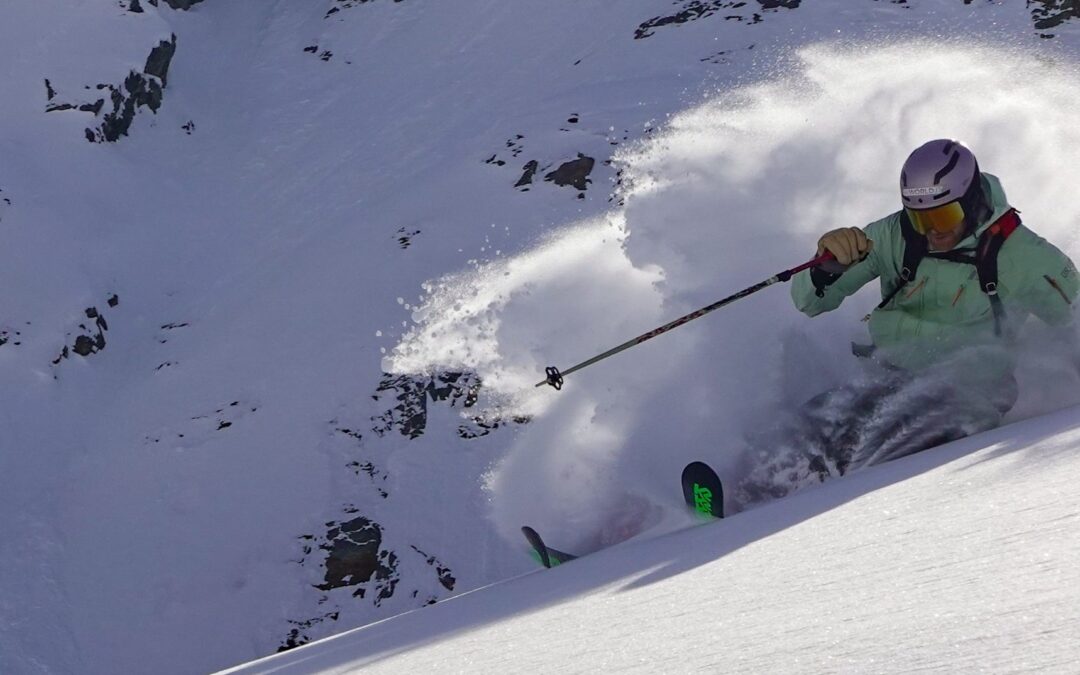
Heli skiing is the best skiing of your life, and it asks a lot of your body. Alaska runs are long, usually 1,500 to 4,000 vertical feet, the snow is deep and changeable, and you’ll do it 6 to 10 times a day. The fitter you arrive, the more you’ll get out of every run, and the better you’ll feel on day three.
Here are training tips from Shanshine, the research behind them, and a simple eight-week plan you can actually stick to.
Before you start: check with your doctor if you’re new to exercise, coming back from an injury or have a health condition. Build up gradually, and back off if something hurts.
1. Join a gym with small group training
Shanshine’s first tip is the one that makes everything else easier: find a gym that offers small group training, and sign up for regular sessions.
It’s good for your wellbeing. In a 12-week study of 69 medical students, the group that did a weekly group workout cut their perceived stress by 26% and improved mental, physical and emotional quality of life by 13%, 25% and 26%. Students who worked out alone, for twice as long on average, saw no significant change in stress (Yorks et al., Journal of the American Osteopathic Association, 2017).
You’ll actually show up. A meta-analysis of 44 studies found that people stick with exercise better when they train as a real group, with shared goals and a sense of belonging, than in a standard class of strangers (Burke et al., 2006). When your coach and your crew expect you on Tuesday, you go.
It’s social. Training with the same people week after week is fun, and it’s a great way to find ski partners, too.
You get coaching. A coach watches your form on squats and lunges, so you get stronger without getting hurt.
2. Train more than strength: agility, balance and sprints
Lifting builds the legs you need, but skiing powder in big terrain also takes quick feet, steady balance and a big engine. Each week, mix in all three.
High-intensity sprints for your engine (VO2 max)
VO2 max is the most oxygen your body can use during hard exercise, and it’s one of the best measures of aerobic fitness. A higher VO2 max means you recover faster between turns, between runs and from one day to the next.
Interval training raises VO2 max efficiently. In one review of 10 studies, high-intensity interval training improved aerobic fitness almost twice as much as steady moderate exercise (Weston et al., British Journal of Sports Medicine, 2014; the participants were adults with lifestyle-related conditions).
A 2023 review of nine studies in national-level athletes also found interval training beat conventional training for improving VO2 max (meta-analysis, 2023).
Try: 30 seconds hard, 90 seconds easy, repeated 6 to 8 times on a bike, rower or hill. Hard means you can’t hold a conversation.
Agility and balance to protect your knees
Variable snow, tracks and terrain changes mean your body is constantly correcting. Balance and agility drills train those reactions, and they’re good injury insurance.
A meta-analysis of 24 studies found that neuromuscular and proprioceptive training (balance, agility and landing drills) reduced knee injuries by about 27% and ACL injuries by about half (Donnell-Fink et al., PLoS ONE, 2015; mostly in team-sport athletes).
Balance: single-leg stands (try eyes closed), single-leg Romanian deadlifts, balance board or BOSU squats.
Agility: lateral skater hops, ladder drills, cone shuffles and quick direction changes, done fresh, at the start of a session.
3. Strength sets that build ski legs
Aim for two strength sessions a week, which matches the U.S. guidelines of muscle-strengthening activity at least 2 days a week (U.S. Department of Health and Human Services). Pick a weight that leaves 2 or 3 good reps in the tank, and add a little weight or a rep each week.
Session A: legs and power
Goblet squat: 3 sets of 8–10. Reverse lunge: 3 sets of 8 per leg. Lateral lunge: 3 sets of 8 per side. Box jump or squat jump: 3 sets of 5 (land softly). Wall sit: 3 holds of 30–60 seconds (the classic ski burn). Side plank: 3 holds of 30 seconds per side.
Session B: posterior chain and core
Romanian deadlift: 3 sets of 8. Step-up: 3 sets of 8 per leg. Single-leg Romanian deadlift: 3 sets of 8 per leg. Glute bridge or hip thrust: 3 sets of 10–12. Pallof press (anti-rotation): 3 sets of 10 per side. Dead bug: 3 sets of 8 per side.
4. Make mobility part of everyday life
Mobility doesn’t need its own gym session. Ten minutes a day, plus small habits, keeps your hips, ankles and back ready for long days and helicopter rides.
Your daily 10 minutes
2-minute deep squat: sink into a full squat with heels down and hold for 2 minutes total (break it up if you need to). Great for ankles, hips and the low ski stance.
Hip openers: 90/90 hip switches, pigeon pose and frog stretch, about a minute each.
Couch stretch for quads: back knee on the floor against a wall or couch, front foot forward, squeeze your glute. One minute per side, and your quads will thank you after a day of long runs.
Dead hang: hang from a pull-up bar for 30 to 60 seconds to decompress your spine and open your shoulders.
Ankle rocks and thoracic rotations to finish.
Everyday habits
Squat, don’t stoop: squat down to pick things up, and sit on the floor while you watch TV.
Take the stairs and get up for a short walk every hour you’re at a desk.
Stretch your calves while you brush your teeth or wait for the coffee.
5. Hot and cold: sauna and cold plunge
Sauna and cold plunges are popular with skiers, and both can help, but timing matters. Here’s what the research says and how to fit them into your plan.
Sauna
A heart-health habit. A 20-year Finnish study of 2,315 men found that those who used a sauna 4 to 7 times a week had a 63% lower risk of sudden cardiac death than those who went once a week, with lower risk of all-cause death too. Sessions longer than 19 minutes were also linked to lower risk (Laukkanen et al., JAMA Internal Medicine, 2015). It’s an observational study, so it shows a link, not proof of cause.
When to use it: after a workout or on easy days to relax and unwind. Start with 10 to 15 minutes and build up.
Be smart: hydrate before and after, skip alcohol, and get out if you feel dizzy.
Cold plunge
Less soreness. A Cochrane review of 17 small trials found cold-water immersion (below 15°C / 59°F) reduced muscle soreness for up to four days after exercise compared with resting, though study quality was low (Cochrane review, CD008262).
A short-term mood boost. A 2025 review of 11 studies and 3,177 people found cold-water immersion reduced stress, but only for about 12 hours afterward (Cain et al., PLOS ONE, 2025).
A morning reset for your mind. Starting your day with a short cold plunge is a great way to train mental strength. The first seconds trigger a gasp and a racing heart, and learning to slow your breath and stay calm through it is a form of meditation. That same skill helps on a steep, exposed line. The research on mental benefits is still early (the 2025 review above found the stress relief lasts about 12 hours), so treat it as a practice, not a cure-all.
Watch the timing. In a 12-week study, men who took a 10-minute ice bath at 10°C (50°F) after twice-weekly strength training gained less muscle and strength than men who did an active cool-down on a bike (Roberts et al., Journal of Physiology, 2015).
How to fit it in: During your build weeks, keep cold plunges away from strength days (use them after sprints or on rest days) so you don’t blunt your gains. A short morning plunge is fine on most days, as long as it isn’t right after a strength session. Save post-workout plunges for your taper week and your trip, when recovering for the next day matters most. Sauna works any time. Start cold with 30 seconds to 2 minutes, never plunge alone, and check with your doctor first if you have a heart condition or high blood pressure, or are pregnant.
Your 8-week ski-shape plan
This plan is built to be doable: about 3 to 4 hours a week, with most days short. It includes two strength sessions, one small-group class, one sprint and agility day, and daily mobility. Start eight weeks before your trip, or run it twice if you have longer. Together with your easy cardio, it meets the U.S. guideline of 150 to 300 minutes of moderate activity a week (HHS).
A typical week
Monday and Thursday are your strength days: Session A on Monday and Session B on Thursday, each about 45 minutes, finishing with 5 minutes of balance work. Tuesday is your small group class at the gym, about 45 to 60 minutes. Wednesday is easy cardio, like a hike, bike ride or walk, plus mobility, for 30 to 45 minutes.
Friday is a rest day, or an easy walk and your daily mobility. Saturday is sprints and agility, about 30 minutes. Sunday is a long, easy day outside: hike, bike or ski tour for an hour or more. Every day, do your 10 minutes of mobility, and if you like, add 10 to 20 minutes of sauna after sessions, or a cold plunge after sprints or on rest days.
How it builds
Weeks 1–2, foundation: do 2 sets of each strength exercise and focus on learning the moves. Sprint 4 rounds of 30 seconds hard and 90 seconds easy. For balance and agility, start with single-leg stands and slow skater steps.
Weeks 3–5, build: move up to 3 sets and add a little weight each week. Sprint 6 rounds of 30 seconds hard and 90 seconds easy, and add skater hops, ladder drills and balance-board squats.
Weeks 6–7, ski-specific: keep 3 sets, and add jumps and longer wall sits. Sprint 8 rounds, and work on fast direction changes and single-leg hops.
Week 8, taper: drop back to 2 sets at the same weight so you arrive fresh. Sprint just 4 rounds, keep the drills light, stay on top of your daily mobility, and enjoy a few cold plunges.
Missed a day? Don’t try to make it up. Just pick up the next session. Consistency over eight weeks matters far more than any single workout.
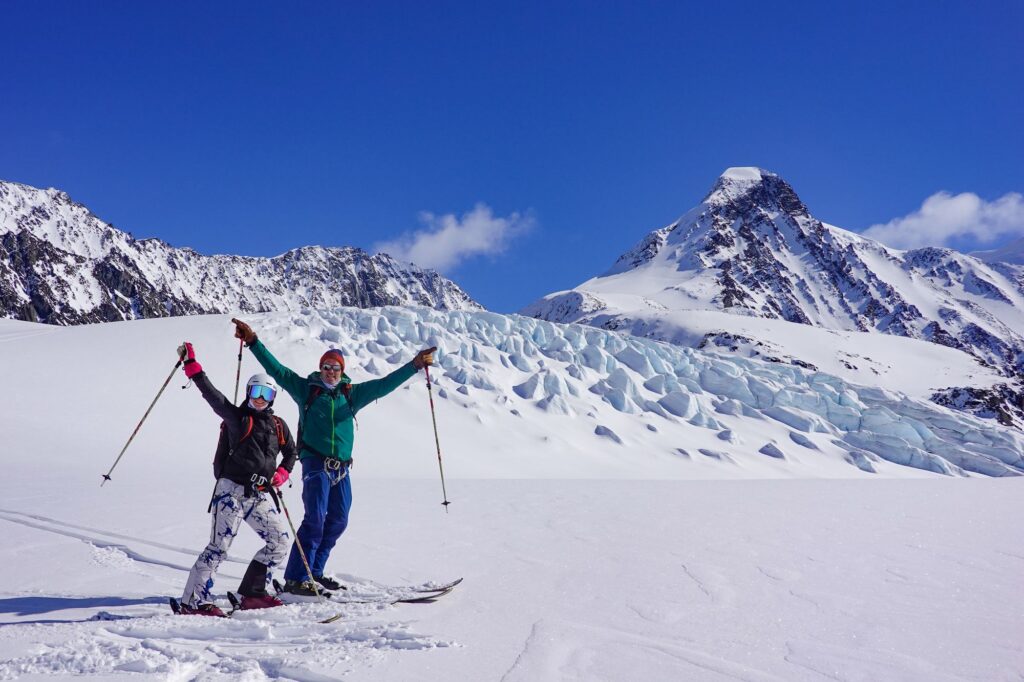
See you in the Chugach
Arriving strong means more runs, more fun and fresher legs on the last day. For everything else you need before your trip, from packing to getting here, see our trip planning page. Questions about whether you’re ready? Call our booking concierge at 1-800-559-8691.
